







Kontekst i wyzwanie
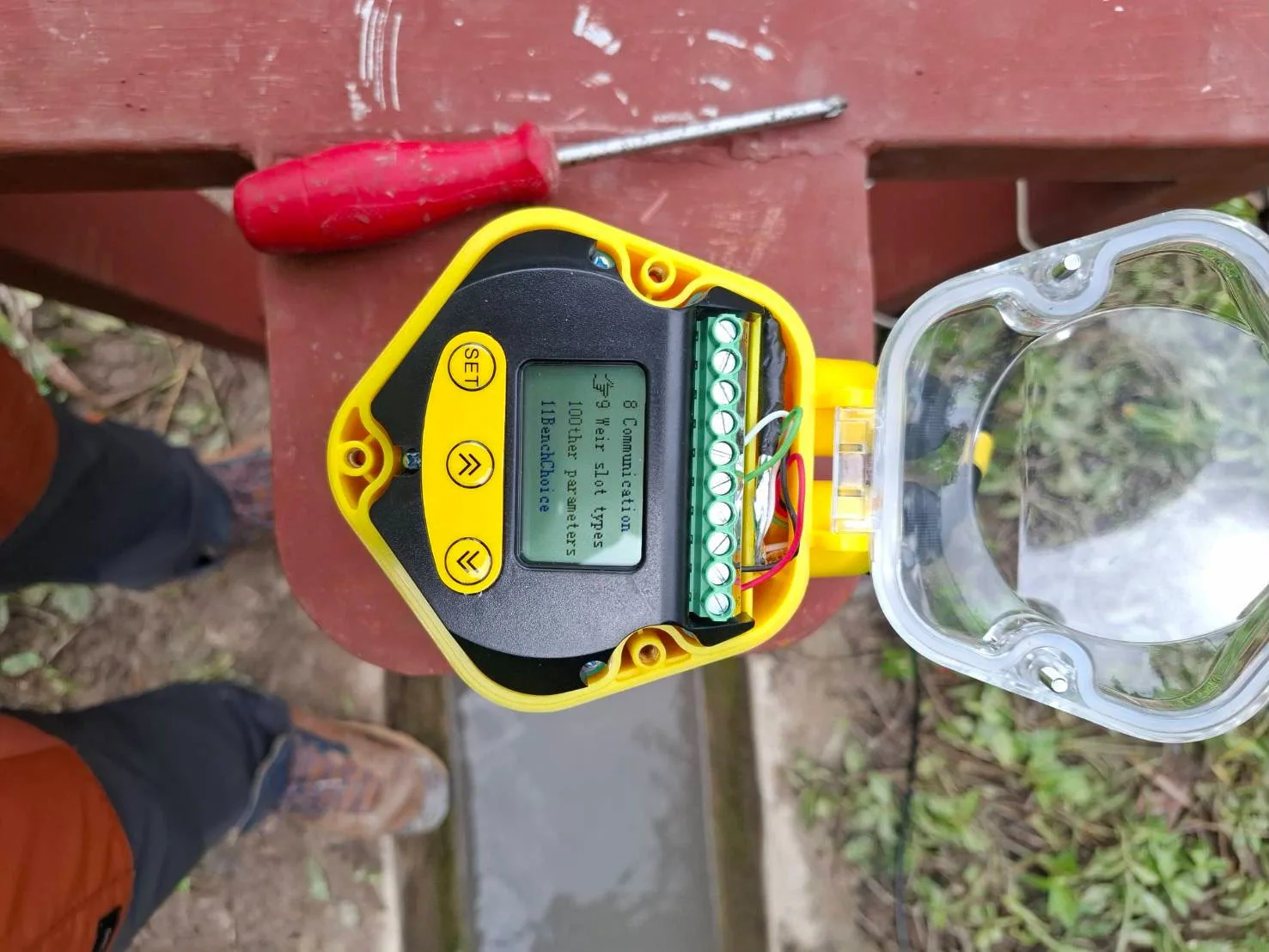
The customer monitors the flow entering a pond in Thailand through an open channel. Because the channel is fitted with a rectangular weir, KOCF3000 ultrasonic open-channel flow meter does not measure flow directly; it measures the water level above the weir and converts that level into a flow rate using the weir equation.
The reported problem was that the flow displayed by the instrument did not agree with the actual flow through the channel. The level reading itself looked plausible, so the error was not obvious from the display alone.
Why the KOCF3000
An ultrasonic open-channel flow meter is a non-contact solution. The sensor is mounted above the channel and never touches the water, so it is not affected by the solids, debris, or algae that foul submerged instruments in an open channel.
The KOCF3000 supports standard hydraulic structures — rectangular weir, V-notch weir, and Parshall flume — and performs the level-to-flow conversion internally, which makes it a good fit where a weir is already installed and only the flow calculation needs to be added.
Rozwiązanie i instalacja
Three points were checked in turn, and all three explained the discrepancy:
- Reference zero point. Menu path range setting → reference zero point. It must be set against the weir, not against the channel floor; otherwise every level is offset, and the flow error changes with depth.
- Probe distance. It must be the distance from the bottom face of the probe to the measuring point on the rectangular weir. It is nie the distance to the water surface shown on the display, which is the value most often entered in error.
- Clear beam path. A horizontal bar beneath the probe was found inside the ultrasonic beam. Anything crossing the beam returns its own echo, so the instrument can lock onto it instead of the water; removal of the bar was recommended.
Wyniki
After the reference zero point was corrected, the probe distance was defined from the probe face to the weir measuring point, and the obstructing bar was dealt with; the flow reading returned to normal and matched the actual flow through the channel.
Produkty powiązane
- KOCF3000A split-type ultrasonic open channel flow metr
- KOCF3000B ultrasonic open channel flow meter
- KLF110 radar flow meter
- Ultrasonic Open Channel Flow Meter (category)
Często zadawane pytania
Q: Why does my open-channel flow meter read the wrong flow?
A: In order of likelihood: the reference zero point is wrong, the probe distance has been entered as the distance to the water surface instead of to the measuring point, or an object in the beam is returning a false echo. Any of the three will corrupt the flow conversion even though the level itself looks reasonable.
Q: What exactly is the probe distance supposed to be?
A: It is the distance from the bottom face of the probe to the measurement point on the hydraulic structure — the rectangular weir in this case. It is not the distance to the water surface displayed on the screen.
Q: Can a metal bar under the sensor really affect the reading?
A: Yes. Ultrasonic measurement needs a clear air path. Any object crossing the beam reflects energy to the sensor, and if that echo is stronger or more consistent than the water surface, the instrument will track it instead.
Q: Does the flow meter measure flow directly?
A: No. It measures level and converts it to flow using the weir or flume equation, which is why the correct entry of the structure type, the zero point, and the probe distance matters so much.
Potrzebujesz podobnego rozwiązania?
Każdy artykuł w tej bibliotece jest zbudowany z prawdziwej aplikacji. Przeglądaj całą kolekcję, aby zobaczyć, jak te instrumenty działają w terenie, lub porozmawiać z naszymi inżynierami aplikacji o swojej instalacji.


