







Gelöster Sauerstoff (DO) ist die Menge an freiem, molekularem Sauerstoff, der in Wasser gelöst ist, normalerweise ausgedrückt in Milligramm Sauerstoff pro Liter (mg/L). Es ist einer der wichtigsten Indikatoren für die Wasserqualität und bestimmt direkt, ob Fische, Garnelen und nützliche Bakterien in einem Teich, einem Tank oder einer Wasserstraße überleben können. Dieser Leitfaden erklärt, wo gelöster Sauerstoff in Wasser kommt davon, was es verbraucht und wie Temperatur, Druck und Salzgehalt beeinflussen, wie viel Sauerstoff Wasser tatsächlich halten kann.

Woher kommt gelöster Sauerstoff in Wasser?
Sauerstoff gelangt über zwei natürliche Hauptwege ins Wasser, plus einen kleineren Beitrag aus dem Wasseraustausch.
1. Atmosphärendiffusion
When the water surface is in contact with air, oxygen molecules diffuse across the surface and dissolve, at a rate that depends on how far the water is from saturation. The more “unsaturated” the water is, the faster this diffusion happens. Wind, wave action, and a large surface-area-to-volume ratio all speed up the process — this is why shallow, wind-exposed ponds pick up oxygen faster than deep, still ones.
2. Photosynthese
Wasserpflanzen, Algen und Phytoplankton setzen Sauerstoff als Nebenprodukt der Photosynthese frei, wenn Sonnenlicht verfügbar ist. In produktiv Aquakulturteiche, this is typically the single largest source of oxygen, often accounting for more than half of total DO input during the day — but it stops completely at night, which is why oxygen levels swing so much between day and night (more on that in Teil 2 dieser Serie).
3. Wasseraustausch
Adding fresh, oxygen-rich water — through rain, tidal exchange, or intentional water replacement in a recirculating system — can raise DO levels. In practice, this contributes far less than diffusion and photosynthesis; in static (non-flow-through) ponds, its effect on oxygen is usually minor.

Was verursacht gelösten Sauerstoffabbau?
Auf der Verbrauchsseite konkurrieren mehrere Prozesse um den Sauerstoff, den Photosynthese und Diffusion in das Wasser bringen.
Atmung von Fischen, Garnelen und anderen Aquakulturtieren. Oxygen consumption per unit of body weight is higher in smaller individuals and rises with water temperature — meaning warm-weather stocking density is far more sensitive to oxygen shortfalls than the same density in cooler water.
Mikrobielle und Planktonatmung. Bakterien, Zooplankton und Phytoplankton verbrauchen alle Sauerstoff durch Atmung, und Bakterien verbrauchen auch Sauerstoff, während sie organische Stoffe zersetzen (unbehandeltes Futter, Abfall, totes Plankton). Dieser Zersetzungsbedarf ist der biochemische Sauerstoffbedarf (BOD)5) tatsächlich Maßnahmen.
Sediment (benthischer) Sauerstoffbedarf. Oxygen is also consumed at the pond bottom by benthic organisms and by the decomposition of settled organic matter and reduced inorganic compounds — a demand that grows as bottom sludge accumulates over a production cycle.
Chemischer Sauerstoffbedarf. Reduced substances such as ammonia, nitrite, sulfide, and ferrous iron all consume oxygen as they’re oxidized (e.g., ammonia → nitrite → nitrate). Chemical oxygen demand (CODCr) is the standard measurement of this reducing load, and — alongside BOD5 and total organic carbon (TOC) — is one of the three common ways labs quantify organic pollution. Facilities that need to track this alongside DO can pair a dissolved oxygen sensor with a COD-Sensor für ein vollständigeres Bild des Sauerstoffbedarfs.
Flucht in die Atmosphäre. When surface water becomes supersaturated, oxygen slowly escapes back into the air; wind speeds this up, but it is generally the smallest term in the oxygen budget.
Gelöste Salze Salts and other dissolved solids physically occupy space between water molecules, which reduces how much oxygen the water can hold — one reason seawater carries less DO than fresh water at the same temperature. This is also why Salinitätsüberwachung wird oft mit DO-Überwachung in Brack- oder Marinesystemen wie Meerwasserentsalzung Ansaugwasser.
Wie Temperatur- und Druckkontrolle Sauerstoffsättigung
The saturation point — the maximum amount of oxygen water can hold at equilibrium with the atmosphere — is governed mainly by temperature, with smaller effects from atmospheric pressure and salinity. This relationship follows Henry’s Law:
[O]2] = KH × pO2
wobei ... O2] die Konzentration des gelösten Sauerstoffs, pO2 Partialdruck von Sauerstoff in der Atmosphäre und KH is Henry’s constant, which falls as temperature rises. In practice, this means:
- Wärmeres Wasser enthält weniger Sauerstoff. As water heats from 10°C to 35°C, the saturation concentration in pure water drops from roughly 11.3 mg/L to under 7 mg/L — which is exactly why summer afternoons are the highest-risk time for oxygen crashes in aquaculture.
- Niedriger atmosphärischer Druck (oder höhere Höhe) reduziert die Sättigung, da es den Partialdruck von Sauerstoff reduziert, der die Diffusion in das Wasser antreibt.
- Höherer Salzgehalt reduziert die Sättigung, weshalb die gleiche DO-Messung in einem Süßwasserteich etwas anderes als ein Brack- oder Meeressystem bedeutet.
Sauerstofflöslichkeit in reinem Wasser bei 1 atm
| Temp (°C) | DO (mg/l) | Temp (°C) | DO (mg/l) | Temp (°C) | DO (mg/l) | Temp (°C) | DO (mg/l) |
|---|---|---|---|---|---|---|---|
| 0 | 14.62 | 8 | 11.87 | 16 | 9.95 | 24 | 8.53 |
| 1 | 14.23 | 9 | 11.59 | 17 | 9.74 | 25 | 8.38 |
| 2 | 13.84 | 10 | 11.33 | 18 | 9.54 | 26 | 8.22 |
| 3 | 13.48 | 11 | 11.08 | 19 | 9.35 | 27 | 8.07 |
| 4 | 13.13 | 12 | 10.83 | 20 | 9.17 | 28 | 7.92 |
| 5 | 12.80 | 13 | 10.60 | 21 | 8.99 | 29 | 7.72 |
| 6 | 12.48 | 14 | 10.37 | 22 | 8.83 | 30 | 7.63 |
| 7 | 12.17 | 15 | 10.15 | 23 | 8.63 |
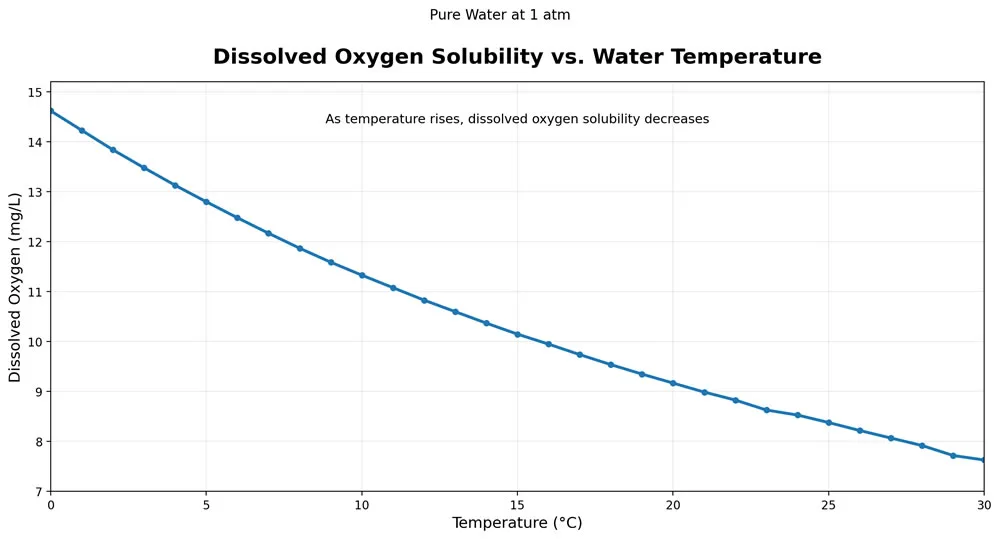
For reference, dissolved oxygen in air-saturated fresh water sits around 8–12 mg/L — less than 1/20 of the oxygen concentration in air itself — while seawater holds noticeably less at the same temperature. For drinking water, a DO level below roughly 6 mg/L is generally considered a sign of poor water quality.
Warum dies für die Überwachung wichtig ist
Da die DO-Sättigung so stark von der Temperatur abhängt, ist eine Messung des rohen gelösten Sauerstoffs nur neben einer Messung der Temperatur und idealerweise einer Berechnung der Sättigung in % sinnvoll. Deshalb ist Production-Grade Sensoren für gelösten Sauerstoff build in automatic temperature compensation — without it, the same water could show very different DO numbers depending on when it was measured.
Continuous, in-situ monitoring — rather than periodic spot checks — is what lets operators catch a developing oxygen deficit before fish start gasping at the surface. Whether you’re monitoring a Abwasser Ein Aufbereitungsbecken oder ein Aquakulturteich, die Prinzipien sind die gleichen. In Teil 2, schauen wir uns an, wie DO durch den Tag und durch die Wassersäule variiert und warum die niedrigsten Sauerstoffwerte fast immer kurz vor Sonnenaufgang auftauchen. Teil 3 geht dann durch Wie gelöste Sauerstoffsensoren tatsächlich funktionieren So können Sie die richtige auswählen.
FAQ
F: Woher kommt gelöster Sauerstoff in Wasser?
A: Sauerstoff gelangt hauptsächlich durch atmosphärische Diffusion über die Wasseroberfläche und durch Photosynthese durch Wasserpflanzen, Algen und Phytoplankton ins Wasser; eine geringere Menge stammt aus Wasseraustausch (Regen, Gezeitenfluss oder absichtlicher Wasseraustausch).
F: Was verursacht den Abbau von gelöstem Sauerstoff in Wasser?
A: Atmung von Fischen und anderen Wassertieren, mikrobielle Atmung und Planktonatmung (einschließlich Zersetzung organischer Stoffe, gemessen als BSB)5), Sedimentsauerstoffbedarf, Oxidation von reduzierten Substanzen wie Ammoniak und Sulfid (gemessen als CSB), Austritt von Sauerstoff in die Atmosphäre und gelöste Salze verbrauchen oder reduzieren den verfügbaren Sauerstoff.
F: Wie beeinflusst die Temperatur den gelösten Sauerstoff in Wasser?
A: Warmer water holds less oxygen. As water heats from 10°C to 35°C, the saturation concentration in pure water falls from roughly 11.3 mg/L to under 7 mg/L, which is why oxygen crashes are most likely on hot summer afternoons.
F: Was ist ein normaler Gehalt an gelöstem Sauerstoff in Wasser?
A: Air-saturated fresh water typically holds about 8–12 mg/L, and seawater holds less at the same temperature. For drinking water, a DO level below roughly 6 mg/L is generally considered a sign of poor water quality.
Literaturverzeichnis
- U.S. Geological Survey Gelöster Sauerstoff und WasserUSGS Water Science School.
- US-EPA, Gelöster Sauerstoff, Causal Analysis/Diagnose Decision Information System (CADDIS).


