







Oksigen terlarut (DO) adalah jumlah bebas, oksigen molekul terlarut dalam air, biasanya dinyatakan dalam miligram oksigen per liter (mg/L). Ini adalah salah satu indikator terpenting kualitas air, dan secara langsung menentukan apakah ikan, udang, dan bakteri yang bermanfaat dapat bertahan di kolam, tangki, atau saluran air. Panduan ini menjelaskan di mana Oksigen terlarut dalam air Berasal dari, apa yang mengkonsumsinya, dan bagaimana suhu, tekanan, dan salinitas mempengaruhi berapa banyak air oksigen dapat benar-benar bertahan.

Dari Mana Asal Airnya?
Oksigen memasuki air melalui dua jalur alami utama, ditambah kontribusi yang lebih kecil dari pertukaran air.
1. Penyebaran Atmosfera
When the water surface is in contact with air, oxygen molecules diffuse across the surface and dissolve, at a rate that depends on how far the water is from saturation. The more “unsaturated” the water is, the faster this diffusion happens. Wind, wave action, and a large surface-area-to-volume ratio all speed up the process — this is why shallow, wind-exposed ponds pick up oxygen faster than deep, still ones.
2. Fotosintesis
Tanaman akuatik, alga, dan fitoplankton melepaskan oksigen sebagai produk sampingan fotosintesis kapanpun sinar matahari tersedia. produktif kolam aquaculture, this is typically the single largest source of oxygen, often accounting for more than half of total DO input during the day — but it stops completely at night, which is why oxygen levels swing so much between day and night (more on that in No 2 dari seri ini).
3. Bursa Air
Adding fresh, oxygen-rich water — through rain, tidal exchange, or intentional water replacement in a recirculating system — can raise DO levels. In practice, this contributes far less than diffusion and photosynthesis; in static (non-flow-through) ponds, its effect on oxygen is usually minor.

Apa Penyebab Lenyapnya Oksigen?
Di sisi konsumsi, beberapa proses bersaing untuk oksigen yang fotosintesis dan difusi dimasukkan ke dalam air.
Kedaluwarsa ikan, udang, dan hewan akuakultur lainnya. Oxygen consumption per unit of body weight is higher in smaller individuals and rises with water temperature — meaning warm-weather stocking density is far more sensitive to oxygen shortfalls than the same density in cooler water.
Mikrobial dan respirasi plankton. Bakteri, zooplankton, dan fitoplankton semua mengkonsumsi oksigen melalui respirasi, dan bakteri juga mengkonsumsi oksigen saat mendekomposisi materi organik (uneaten pakan, limbah, plankton mati). Permintaan dekomposisi ini adalah apa yang diminta oleh biokimia oksigen (BOD5Sebenarnya langkah-langkah.
Permintaan oksigen untuk Sedimen (benthic). Oxygen is also consumed at the pond bottom by benthic organisms and by the decomposition of settled organic matter and reduced inorganic compounds — a demand that grows as bottom sludge accumulates over a production cycle.
Permintaan oksigen kimia. Reduced substances such as ammonia, nitrite, sulfide, and ferrous iron all consume oxygen as they’re oxidized (e.g., ammonia → nitrite → nitrate). Chemical oxygen demand (COD♪ Cr) is the standard measurement of this reducing load, and — alongside BOD5 and total organic carbon (TOC) — is one of the three common ways labs quantify organic pollution. Facilities that need to track this alongside DO can pair a dissolved oxygen sensor with a Sensor COD Untuk gambaran penuh permintaan oksigen.
Melarikan diri ke atmosfer. When surface water becomes supersaturated, oxygen slowly escapes back into the air; wind speeds this up, but it is generally the smallest term in the oxygen budget.
Garam yang dilarutkan. Salts and other dissolved solids physically occupy space between water molecules, which reduces how much oxygen the water can hold — one reason seawater carries less DO than fresh water at the same temperature. This is also why Pemantauan salinitas sering dipasangkan dengan pemantauan DO dalam sistem barackish atau laut seperti penyahgaraman air laut Air masuk.
Kejenuhan Oksigen Pengendalian Suhu dan Tekanan
The saturation point — the maximum amount of oxygen water can hold at equilibrium with the atmosphere — is governed mainly by temperature, with smaller effects from atmospheric pressure and salinity. This relationship follows Henry’s Law:
[O]2♪ ♪ ♪ KH × pO2
Di mana [ Perancis2Ini adalah konsentrasi oksigen terlarut, pO2 Medik parsial oksigen di atmosfer, dan KH is Henry’s constant, which falls as temperature rises. In practice, this means:
- Air yang lebih sedikit mengandung oksigen. As water heats from 10°C to 35°C, the saturation concentration in pure water drops from roughly 11.3 mg/L to under 7 mg/L — which is exactly why summer afternoons are the highest-risk time for oxygen crashes in aquaculture.
- Tekanan atmosfer yang lebih rendah (atau ketinggian lebih tinggi) menyebabkan kejenuhan berkurangKarena itu mengurangi tekanan parsial oksigen mendorong difusi ke dalam air.
- salinitas yang lebih tinggi untuk mengurangi kejenuhanItu sebabnya, membaca DO yang sama berarti sesuatu yang berbeda di kolam air tawar melawan sistem rawa atau laut.
Oksigen Solubilitas di Air Murni pada 1 atm
| Temp (°C) | DO (mg/L) | Temp (°C) | DO (mg/L) | Temp (°C) | DO (mg/L) | Temp (°C) | DO (mg/L) |
|---|---|---|---|---|---|---|---|
| 0 | 14.62 | 8 | 11.87 | 16 | 9.95 | 24 | 8.53 |
| 1 | 14.23 | 9 | 11.59 | 17 | 9.74 | 25 | 8.38 |
| 2 | 13.84 | 10 | 11.33 | 18 | 9.54 | 26 | 8.22 |
| 3 | 13.48 | 11 | 11.08 | 19 | 9.35 | 27 | 8.07 |
| 4 | 13.13 | 12 | 10.83 | 20 | 9.17 | 28 | 7.92 |
| 5 | 12.80 | 13 | 10.60 | 21 | 8.99 | 29 | 7.72 |
| 6 | 12.48 | 14 | 10.37 | 22 | 8.83 | 30 | 7.63 |
| 7 | 12.17 | 15 | 10.15 | 23 | 8.63 |
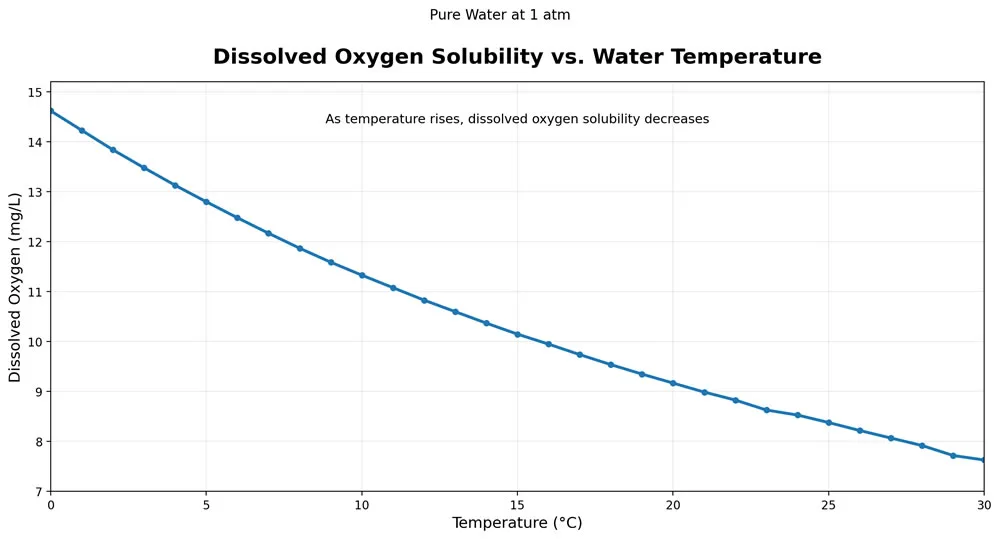
For reference, dissolved oxygen in air-saturated fresh water sits around 8–12 mg/L — less than 1/20 of the oxygen concentration in air itself — while seawater holds noticeably less at the same temperature. For drinking water, a DO level below roughly 6 mg/L is generally considered a sign of poor water quality.
Mengapa Hal Ini Penting untuk Pemantauan
Karena kejenuhan DO sangat bergantung pada suhu, pembacaan oksigen terlarut mentah hanya berarti di samping pembacaan suhu dan, idealnya, perhitungan %-saturasi. Inilah sebabnya mengapa produksi-grade penderia oksigen terlarut build in automatic temperature compensation — without it, the same water could show very different DO numbers depending on when it was measured.
Continuous, in-situ monitoring — rather than periodic spot checks — is what lets operators catch a developing oxygen deficit before fish start gasping at the surface. Whether you’re monitoring a air sisa Besen perawatan vincy atau kolam akuakultur, prinsipnya sama. ♪ In ♪ part 2Kami melihat bagaimana DO bervariasi sepanjang hari dan melalui kolom air, dan mengapa tingkat oksigen terendah hampir selalu muncul tepat sebelum fajar. {\\cH5EFFFF}Bagian 3 kemudian berjalan melalui Bagaimana sensor oksigen dilarutkan bekerja Jadi kau bisa memilih yang benar.
Soalan Lazim
Dari mana asalnya oksigen terlarut dalam air?
AA: Oksigen ke dalam air terutama melalui difusi atmosfer melintasi permukaan air dan melalui fotosintesis oleh tumbuhan akuatik, alga, dan fitoplankton; jumlah yang lebih kecil berasal dari pertukaran air (air, aliran pasang surut, atau penggantian air yang disengaja).
Apa penyebab penipisan oksigen terlarut dalam air?
AA: Kedaluwarsa oleh ikan dan hewan akuatik lainnya, mikrobial dan respirasi plankton (termasuk dekomposisi zat organik, diukur sebagai BOD5), permintaan oksigen sedimen, oksidasi zat tereduksi seperti amonia dan sulfida (diukur sebagai COD), keluar dari oksigen ke atmosfer, dan garam terlarut semua mengkonsumsi atau mengurangi oksigen yang tersedia.
Bagaimana suhu mempengaruhi oksigen terlarut dalam air?
AA: Warmer water holds less oxygen. As water heats from 10°C to 35°C, the saturation concentration in pure water falls from roughly 11.3 mg/L to under 7 mg/L, which is why oxygen crashes are most likely on hot summer afternoons.
Apa kadar oksigen terlarut normal dalam air?
AA: Air-saturated fresh water typically holds about 8–12 mg/L, and seawater holds less at the same temperature. For drinking water, a DO level below roughly 6 mg/L is generally considered a sign of poor water quality.
Rujukan
- Survei Geologi Amerika Serikat, Oksigen dan Air yang TerlarutSekolah Ilmu Air USGS.
- U.S. EPA, Oksigen terlarut, Analisis Kausal/Diagnosis Sistem Informasi Keputusan (CADDIS).


