







Opgelost zuurstof (DO) is de hoeveelheid vrije, moleculaire zuurstof opgelost in water, meestal uitgedrukt in milligram zuurstof per liter (mg/l). Het is een van de belangrijkste indicatoren van de waterkwaliteit, en het direct bepaalt of vis, garnalen, en gunstige bacteriën kunnen overleven in een vijver, tank, of waterweg. Deze gids legt uit waar opgeloste zuurstof in water komt van, wat verbruikt het, en hoe temperatuur, druk en zoutgehalte invloed hebben op hoeveel zuurstof water eigenlijk kan houden.

Waar komt opgeloste zuurstof in water vandaan?
Zuurstof komt water binnen via twee natuurlijke hoofdwegen, plus een kleinere bijdrage van wateruitwisseling.
1. Atmosferische diffusion
When the water surface is in contact with air, oxygen molecules diffuse across the surface and dissolve, at a rate that depends on how far the water is from saturation. The more “unsaturated” the water is, the faster this diffusion happens. Wind, wave action, and a large surface-area-to-volume ratio all speed up the process — this is why shallow, wind-exposed ponds pick up oxygen faster than deep, still ones.
2. Fotosynthese
Waterplanten, algen en fytoplankton geven zuurstof vrij als bijproduct van fotosynthese wanneer zonlicht beschikbaar is. In productieve aquacultuurvijvers, this is typically the single largest source of oxygen, often accounting for more than half of total DO input during the day — but it stops completely at night, which is why oxygen levels swing so much between day and night (more on that in Deel 2 van deze serie).
3. Wateruitwisseling
Adding fresh, oxygen-rich water — through rain, tidal exchange, or intentional water replacement in a recirculating system — can raise DO levels. In practice, this contributes far less than diffusion and photosynthesis; in static (non-flow-through) ponds, its effect on oxygen is usually minor.

Wat is de oorzaak van het oplossen van zuurstofontbranding?
Aan de consumptiekant concurreren verschillende processen om de zuurstof die fotosynthese en diffusie in het water brengt.
Inademing van vissen, garnalen en andere aquacultuurdieren. Oxygen consumption per unit of body weight is higher in smaller individuals and rises with water temperature — meaning warm-weather stocking density is far more sensitive to oxygen shortfalls than the same density in cooler water.
Microbiaal en plankton ademhaling. Bacteriën, zoöplankton en fytoplankton verbruiken allemaal zuurstof via ademhaling, en bacteriën verbruiken ook zuurstof tijdens het ontbinden van organisch materiaal (unatenvoer, afval, dood plankton). Deze ontledingsvraag is wat biochemische zuurstofvraag (BOD)5) daadwerkelijk maatregelen.
Sediment (benthische) zuurstofbehoefte. Oxygen is also consumed at the pond bottom by benthic organisms and by the decomposition of settled organic matter and reduced inorganic compounds — a demand that grows as bottom sludge accumulates over a production cycle.
Chemische zuurstofvraag. Reduced substances such as ammonia, nitrite, sulfide, and ferrous iron all consume oxygen as they’re oxidized (e.g., ammonia → nitrite → nitrate). Chemical oxygen demand (CODCr) is the standard measurement of this reducing load, and — alongside BOD5 and total organic carbon (TOC) — is one of the three common ways labs quantify organic pollution. Facilities that need to track this alongside DO can pair a dissolved oxygen sensor with a COD-sensor voor een vollediger beeld van de zuurstofbehoefte.
Ontsnap naar de atmosfeer. When surface water becomes supersaturated, oxygen slowly escapes back into the air; wind speeds this up, but it is generally the smallest term in the oxygen budget.
Opgelost zout. Salts and other dissolved solids physically occupy space between water molecules, which reduces how much oxygen the water can hold — one reason seawater carries less DO than fresh water at the same temperature. This is also why Saliniteitscontrole wordt vaak gekoppeld aan DO monitoring in brakke of mariene systemen zoals ontzilting van zeewater inlaatwater.
Hoe temperatuur en druk controle zuurstofverzadiging
The saturation point — the maximum amount of oxygen water can hold at equilibrium with the atmosphere — is governed mainly by temperature, with smaller effects from atmospheric pressure and salinity. This relationship follows Henry’s Law:
[O2] = KH × pO2
waarbij [ O2] is de opgeloste zuurstofconcentratie, pO2 is de partiële druk van zuurstof in de atmosfeer, en KH is Henry’s constant, which falls as temperature rises. In practice, this means:
- Warmer water bevat minder zuurstof. As water heats from 10°C to 35°C, the saturation concentration in pure water drops from roughly 11.3 mg/L to under 7 mg/L — which is exactly why summer afternoons are the highest-risk time for oxygen crashes in aquaculture.
- Lagere atmosferische druk (of hogere hoogte) vermindert verzadiging, aangezien het vermindert de gedeeltelijke druk van zuurstof drijven diffusie in het water.
- Hoger zoutgehalte vermindert verzadiging, dat is waarom dezelfde DO lezing betekent iets anders in een zoetwatervijver versus een brak of marine systeem.
Zuurstofoplosbaarheid in zuiver water bij 1 atm
| Temp (°C) | DO (mg/l) | Temp (°C) | DO (mg/l) | Temp (°C) | DO (mg/l) | Temp (°C) | DO (mg/l) |
|---|---|---|---|---|---|---|---|
| 0 | 14.62 | 8 | 11.87 | 16 | 9.95 | 24 | 8.53 |
| 1 | 14.23 | 9 | 11.59 | 17 | 9.74 | 25 | 8.38 |
| 2 | 13.84 | 10 | 11.33 | 18 | 9.54 | 26 | 8.22 |
| 3 | 13.48 | 11 | 11.08 | 19 | 9.35 | 27 | 8.07 |
| 4 | 13.13 | 12 | 10.83 | 20 | 9.17 | 28 | 7.92 |
| 5 | 12.80 | 13 | 10.60 | 21 | 8.99 | 29 | 7.72 |
| 6 | 12.48 | 14 | 10.37 | 22 | 8.83 | 30 | 7.63 |
| 7 | 12.17 | 15 | 10.15 | 23 | 8.63 |
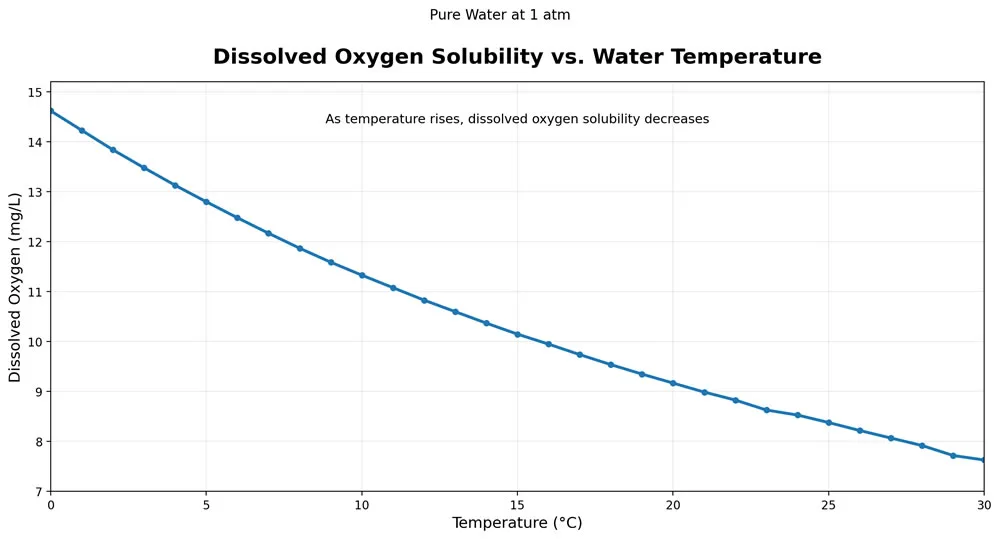
For reference, dissolved oxygen in air-saturated fresh water sits around 8–12 mg/L — less than 1/20 of the oxygen concentration in air itself — while seawater holds noticeably less at the same temperature. For drinking water, a DO level below roughly 6 mg/L is generally considered a sign of poor water quality.
Waarom dit belangrijk is voor toezicht
Omdat de verzadiging van DO zo sterk afhankelijk is van de temperatuur, is een ruwe meting van opgeloste zuurstof alleen zinvol naast een temperatuurmeting en, idealiter, een berekening van %-verzadiging. Dit is de reden waarom productie-kwaliteit sensoren voor opgeloste zuurstof build in automatic temperature compensation — without it, the same water could show very different DO numbers depending on when it was measured.
Continuous, in-situ monitoring — rather than periodic spot checks — is what lets operators catch a developing oxygen deficit before fish start gasping at the surface. Whether you’re monitoring a afvalwater behandelingsgebied of een aquacultuurvijver, de principes zijn hetzelfde. In Deel 2, we kijken hoe DO varieert door de dag en door de waterkolom, en waarom de laagste zuurstofniveaus bijna altijd verschijnen vlak voor zonsopgang. Deel 3 loopt dan door hoe opgeloste zuurstofsensoren werken Zodat je de juiste kunt kiezen.
FAQ
V: Waar komt opgeloste zuurstof in water vandaan?
A: Zuurstof komt water binnen voornamelijk door atmosferische diffusie over het wateroppervlak en door fotosynthese door waterplanten, algen en fytoplankton; een kleinere hoeveelheid komt uit wateruitwisseling (regen, getijdenstroom, of opzettelijke watervervanging).
V: Wat veroorzaakt opgeloste zuurstofdepletie in water?
A: Respiratie door vissen en andere waterdieren, microbiële en planktonademhaling (inclusief afbraak van organische stoffen, gemeten als BOD)5), zuurstofbehoefte in sedimenten, oxidatie van gereduceerde stoffen zoals ammoniak en sulfide (gemeten als COD), ontsnappen van zuurstof naar de atmosfeer, en opgeloste zouten consumeren of verminderen alle beschikbare zuurstof.
V: Hoe beïnvloedt temperatuur opgeloste zuurstof in water?
A: Warmer water holds less oxygen. As water heats from 10°C to 35°C, the saturation concentration in pure water falls from roughly 11.3 mg/L to under 7 mg/L, which is why oxygen crashes are most likely on hot summer afternoons.
V: Wat is een normaal opgeloste zuurstofgehalte in water?
A: Air-saturated fresh water typically holds about 8–12 mg/L, and seawater holds less at the same temperature. For drinking water, a DO level below roughly 6 mg/L is generally considered a sign of poor water quality.
Bronvermeldingen
- U.S. Geologische enquête, Opgelost zuurstof en water, USGS Water Science School.
- US EPA, Opgeloste zuurstof, Causal Analysis/Diagnosis Decision Information System (CADDIS).


