







Why is polyurethane mixing with an agitator a difficult level measurement environment?
Polyurethane mixing vessels combine three measurement challenges simultaneously: high viscosity (800–3,000 mPa·s depending on formulation), mechanical agitation creating turbulent surface conditions, and vapor condensation that coats any probe or antenna surface. The polyurethane batch in this case study is processed in a 2,000L stainless steel mixing tank with an anchor-style agitator rotating at 45–60 RPM. Before replacing the measurement system, the plant relied on a guided wave radar (GWR) that produced erratic readings — the probe wire flexed from the agitator flow, and material buildup on the probe caused progressive drift requiring weekly recalibration.
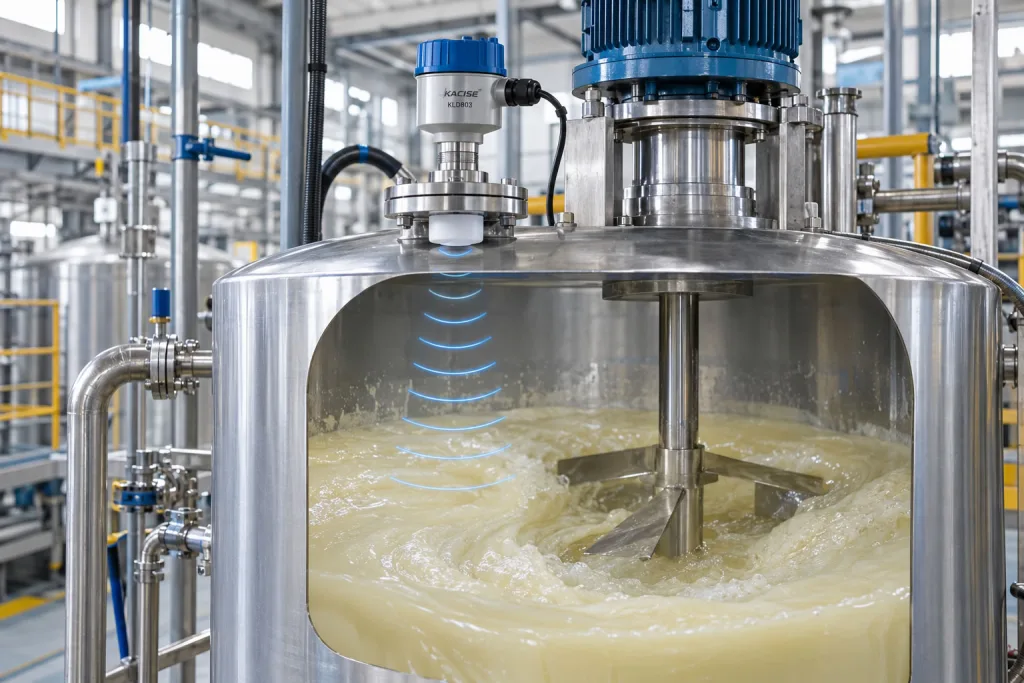
How does the 80GHz KLD803 radar level meter maintain stable readings in a polyurethane agitator environment?
De KLD803 operates at 80GHz (W-band) with a narrow 3° beam angle, which is the critical technical advantage in this application. The narrow beam concentrates the radar signal on the liquid surface rather than reflecting off the agitator blades, tank walls, or internal baffles. At a typical mounting distance of 1.5m from the liquid surface, the beam footprint on the polyurethane surface is only 80mm in diameter — compared to a 24GHz radar with a 20° beam angle that would illuminate a 530mm diameter area and pick up agitator blade reflections.
- Frequency: 80GHz FMCW (76–81 GHz)
- Beam angle: 3° (standard horn antenna)
- Accuracy: ±2mm at ranges up to 30m
- Update rate: 50ms for real-time tracking of agitated surface movement
- Antenna material: PTFE encapsulated — resistant to polyurethane adhesion
Installation — what was required to replace the GWR with the KLD803?
The existing GWR probe was removed from the tank’s DN80 top flange. The KLD803 was mounted directly on the same flange using an adapter, with no tank modification needed. The 80GHz horn antenna extends 120mm below the flange, positioned to clear the maximum liquid fill level by 300mm. The recommended mounting location was verified using a site survey with a laser distance meter to ensure the 3° beam cone would not intersect the agitator shaft at any level between empty and full. Total installation downtime was 1.5 hours — the line returned to production within the same shift.

Measured results — what stability improvement did the plant achieve?
Over 8 weeks of continuous operation across 96 polyurethane batches (four formulations with viscosities from 800 to 2,800 mPa·s), the KLD803 maintained reading stability within ±3mm standard deviation vs. ±28mm from the previous GWR. The measurement success rate — defined as readings that did not require manual override or re-calibration — was 99.4% compared to 71% with the GWR. The plant operators reported zero false high-level alarms, which had previously occurred 2–3 times per week when the GWR mistook agitator blades for the liquid surface.
Performance comparison — 80GHz radar vs. guided wave radar in agitated viscous media
| Parameter | Old GWR (Guided Wave Radar) | KLD803 80GHz FMCW Radar |
|---|---|---|
| Werkingsprincipe | Time-domain reflectometry along probe wire | FMCW through air (non-contact) |
| Reading stability (σ) | ±28mm (agitator flow bends probe, surface turbulence) | ±3mm (3° beam ignores agitator reflections) |
| Measurement success rate | 71% (requiring manual override ~29% of readings) | 99.4% |
| False high-level alarms per week | 2–3 (agitator blade reflection) | 0 |
| Material buildup on sensor | Significant (probe coating causes drift) | Minimal (PTFE horn resists adhesion, no probe) |
| Calibration frequency | Weekly (probe coating + drift) | None in 8-week trial |
What operational impact did the measurement improvement have on batch production?
| Operational metric | Before (GWR) | After (KLD803) |
|---|---|---|
| Unplanned downtime (hours per month) | 6.5 (recalibration, false alarms, probe cleaning) | 0.5 (single confirmation visit) |
| Batches affected by overfill / false-empty events | 8–12% of batches | 1 batch (level alarm confirmed, no material loss) |
| Operator attention required per shift | 45 minutes (checking level reading, manual override) | 3 minutes (glance at display) |
| Recalibration events | Weekly (probe coating and drift) | None during the 8-week trial |
Conclusion — is 80GHz radar the right choice for polyurethane agitator tanks?
Yes, the KLD803 80GHz radar level meter is clearly superior to guided wave radar for polyurethane agitator applications. The 3° beam angle is the decisive feature — it isolates the measurement to the liquid surface and rejects reflections from agitator blades, tank walls, and internal structures. One limitation: if foam builds up to more than 200mm thickness on the liquid surface, the 80GHz signal may attenuate by 6–10 dB and produce a weak return echo. In such cases, stilling well installation or a purge system for foam management should be considered, though this foam condition was not observed during the 8-week trial.
For application details: KLD803 80GHz radar level sensor product page · influence of dielectric constant on radar level meters · contact technical support · 80GHz radar selection guide.
External reference: ISO 21809 — Industrial Process Measurement · AWWA Standards for Process Instrumentation
Veelgestelde vragen over de implementatie
Q: What site conditions should be verified before deploying this solution?
A: A site survey should confirm the measurement range, environmental temperature range, available power supply, and communication network coverage before specifying the sensor model and accessories.
Q: What is the typical installation time for this type of system?
A: A standard installation by two technicians typically requires 4–8 hours depending on bracket fabrication, wiring, and platform configuration. No specialized tooling beyond standard electrical and mechanical tools is needed.
Q: How often should the sensor be calibrated or maintained?
A: For continuous operation in stable environments, an annual calibration check and visual inspection are sufficient. Harsh environments with heavy dust, vapor, or temperature extremes may require semi-annual inspection.
Q: Can the sensor be integrated with existing SCADA or IoT platforms?
A: Yes, the sensor supports standard 4–20 mA and RS485 Modbus RTU interfaces, which are compatible with most PLC, DCS, and SCADA systems. Cloud platform integration requires a DTU or gateway for wireless data transmission.
V: Wat gebeurt er als de sensor geen stroom meer heeft of de netwerkverbinding verliest?
A: The sensor resumes operation automatically when power is restored. For network-dependent wireless systems, ensure the data logger has local storage to buffer readings during communication outages.


