







1. Project Background
At a modern rice cultivation demonstration base in Yulin, Guangxi Province, farmers manage water and nutrients precisely to optimize crop yield. Monitoring dissolved carbon dioxide (CO₂) in irrigation channels and standing water helps understand soil respiration, root activity, and greenhouse gas dynamics.
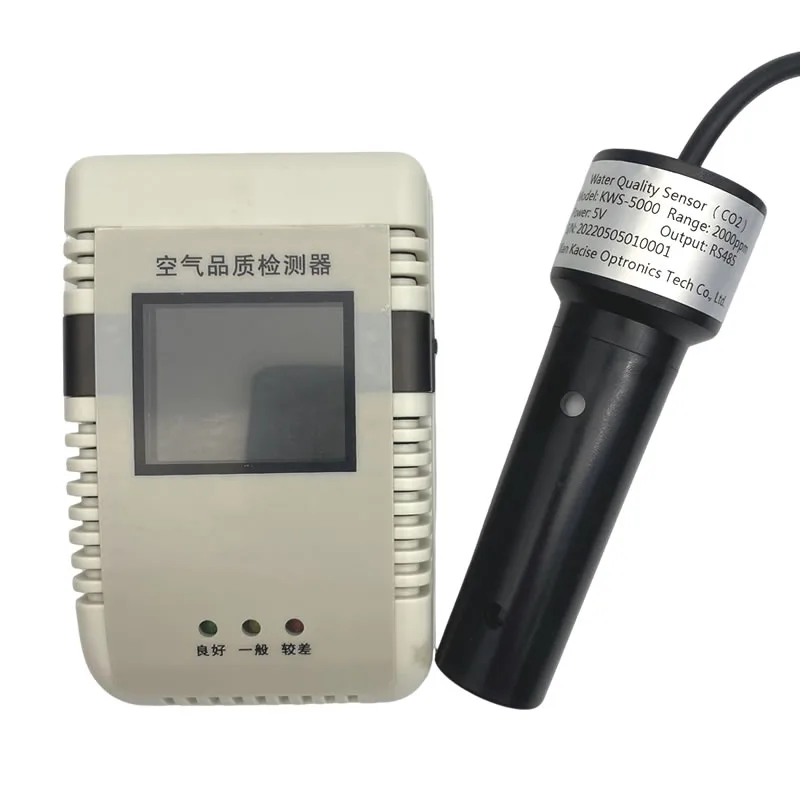
To support precision water management, the KWS-5000 dissolved CO₂ sensor was deployed for continuous online measurement of CO₂ in the flooded rice fields.

2. Site Conditions and Monitoring Requirements
The demonstration base includes multiple adjacent rice paddies with controlled irrigation. Key requirements:
- Water type: Irrigation channels and flooded rice fields
- Monitoring purpose: Continuous dissolved CO₂ monitoring
- Signal output: RS485 (Modbus RTU) for direct integration with the farm’s terminal system
- Installation: Immersion probe in shallow paddy water
- Environment: Muddy, algae-prone water typical of rice cultivation
The system must operate reliably under normal field conditions and provide accurate CO₂ readings for agronomic decisions.
3. System Configuration
The core device is the KWS-5000 dissolved CO₂ sensor:
- NDIR (non-dispersive infrared) measurement technology
- RS485 Modbus RTU output, directly linked to the farm’s monitoring terminal
- IP68 waterproof structure for continuous immersion
- Detachable protective sleeve for easy cleaning in muddy conditions
4. Installation and Commissioning
Steps for deployment:
- Identify representative points in irrigation channels and flooded paddies.
- Mount the sensor on a stable bracket, ensuring the probe head is submerged and protected from debris.
- Connect the RS485 output to the farm’s terminal system.
- Perform initial calibration using reference water.
Installation did not interfere with daily irrigation operations and ensured easy access for maintenance.
You want to know: How to use the KWS-5000 Dissolved CO₂ Sensor?
5. Operational Performance
After deployment, the sensor provided continuous CO₂ data:
- Irrigation channel CO₂ concentration: ~1 300–4 200 ppm
- Flooded rice field water: ~1 000–3 500 ppm
- Observed patterns: Peaks in mid-day correlating with root respiration and temperature rise; lower values in the early morning
These insights enabled agronomists to optimize irrigation and water management, ensuring healthy root zones and balanced nutrient cycling.
6. Project Summary
The KWS-5000 dissolved CO₂ sensor successfully delivered real-time monitoring of CO₂ levels in rice paddy water using direct RS485 integration with the farm’s terminal system. The deployment provided actionable data for irrigation and water quality management, supporting sustainable and precise rice cultivation.
For more technical details, wiring diagrams, or model selection guidance, please click here to learn more or contact our technical team.


