



1.Introduction
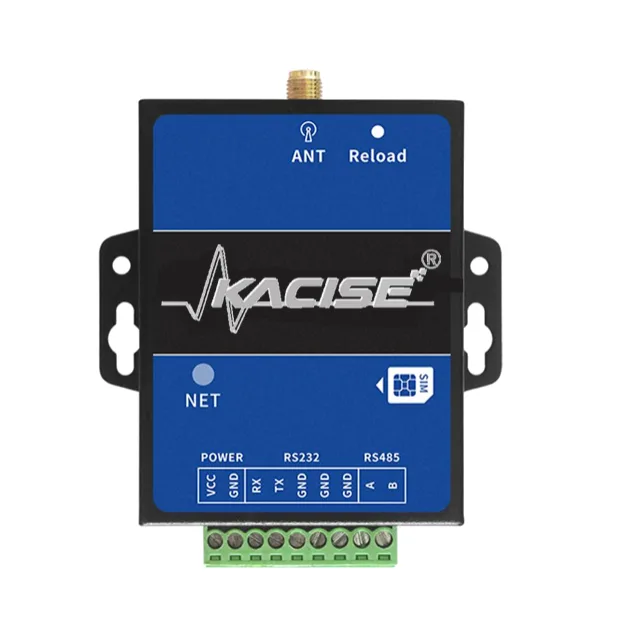
The 4G DTU is suitable for scenarios such as equipment control, status detection, and sensor data collection, where communication with the server is carried out via a 4G network. Its specific functional features are as follows:
- It supports a wide input voltage range of 5 – 36V.
- It supports contact discharge of ±8KV and air discharge of ±15KV.
- The working environment ranges from – 35℃ to 75℃.
- It supports global 4G + 2G frequency bands.
- It supports 1 – way RS485.
- It supports 1 – way RS232.
- It supports a hardware watchdog, ensuring stable operation without crashing.
- It supports the DTU transparent transmission firmware and is compatible with TCP, UDP, MQTT, HTTP, Alibaba Cloud IOT, and Tencent IOT.
- It supports customized label logo services.
It supports secondary development customization.
2.Hardware specifications
| Functional items | Detailed description | |
| 4G module | Network standards | Cat1 Global 4G+2G |
| Network frequency bands | LTE-FDD:B1/B2/B3/B4/B5/B7/B8/B12/B13/B17/B18/B19/B20/
B25/B26/B28/B66 LTE-TDD:B38/B40/B41 GSM:850/900/1800/1900 |
|
| Power parameters | 5 – 36V, 10W power supply. A power supply above 5V is recommended. | |
| Operating environment | Operating temperature | -35℃ ~+75℃ |
| Operating humidity | 5% – 95%RH (non – condensing) | |
| RS232 serial port | Quantity | 1 channel |
| 1200 – 460800; Data bits: 8; Stop bits: 1, 2; Parity bit: odd, even, none | ||
| RS485 serial port | Quantity | 1 channel |
| 1200 – 230400; Data bits: 8; Stop bits: 1, 2; Parity bit: odd, even, none | ||
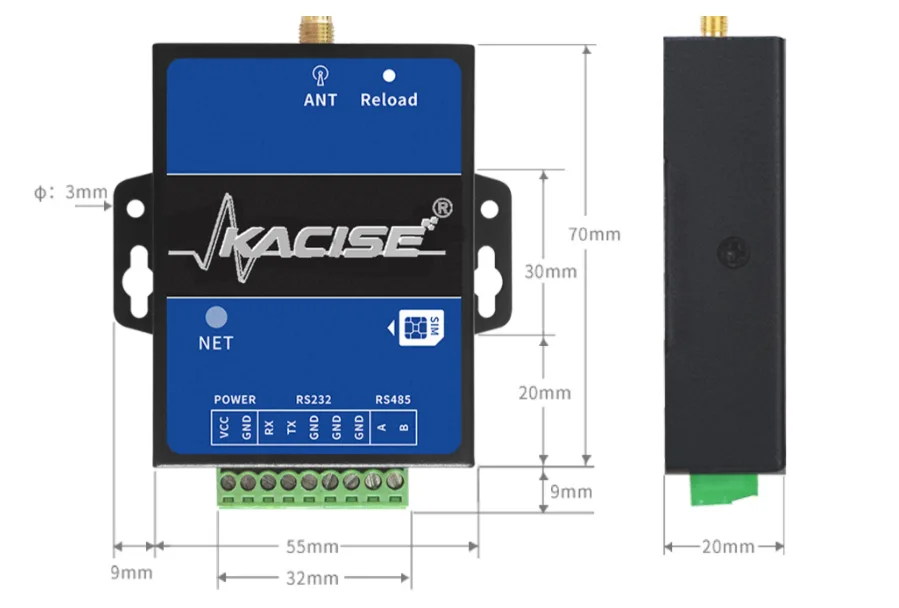
| Dimensions | 73*88*20mm | |
| Installation method | Installation with M3 screws | |
3.Dimension