







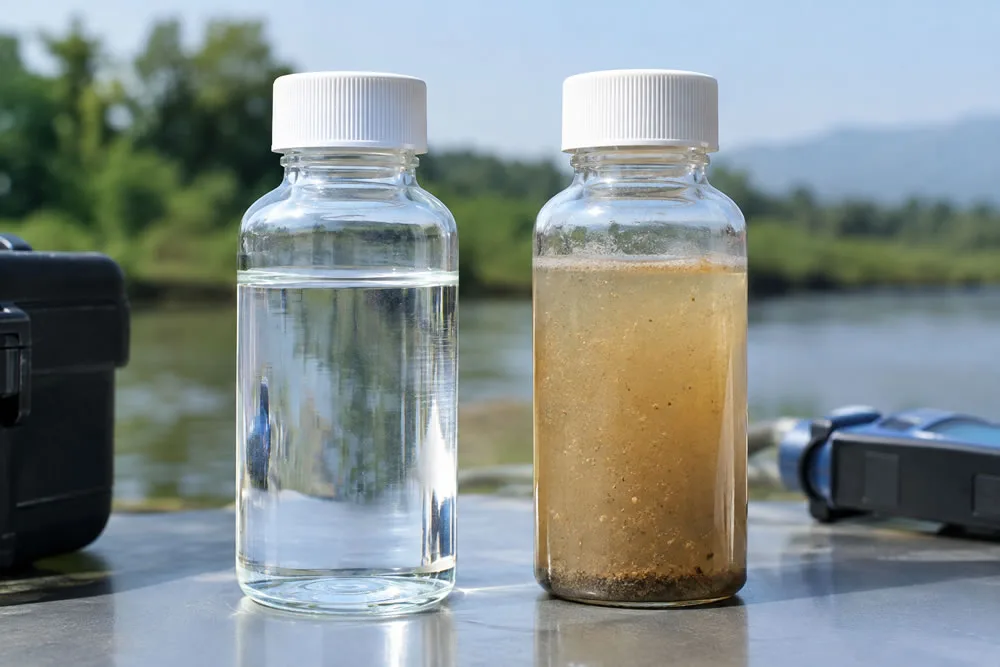
Total suspended solids (TSS) monitoring provides a practical way to track changes in suspended material in water. For wastewater treatment, industrial processes, surface water, and other applications, continuous TSS data can help operators identify changes, evaluate treatment performance, and support process and discharge control. Online TSS sensors make this information available without relying entirely on laboratory testing.
Why Is TSS Monitoring Important?
The importance of TSS monitoring comes from what changes in suspended solids can reveal about a water system. A rising or fluctuating TSS value may be associated with changes in flow, erosion, solids separation, treatment performance, or wastewater conditions. Continuous monitoring helps operators see these changes as they occur rather than only after a sample has been collected and analyzed.
| Monitoring purpose | What TSS data can show | Why it matters |
|---|---|---|
| Treatment process control | Changes in suspended solids through treatment stages | Helps assess settling, filtration, and solids-removal performance |
| Wastewater and discharge monitoring | Changes in solids concentration in process or effluent streams | Supports process control and discharge monitoring |
| Surface-water monitoring | Changes associated with runoff, erosion, or resuspension | Helps identify unusual changes in water conditions |
| Environmental monitoring | Long-term trends in suspended material | Provides data for investigating changes in aquatic environments |
| Operational response | Rapid increases or abnormal trends | Allows operators to investigate conditions while they are occurring |
How Do TSS Sensors Support Water Quality Monitoring?
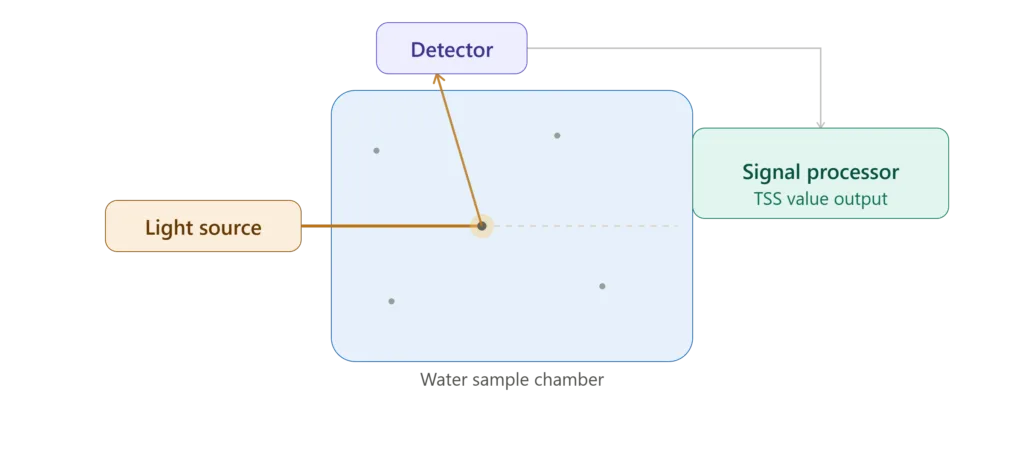
Online TSS sensors use optical measurements to estimate suspended-solids concentration. The sensor detects the interaction between light and particles in the water, and the resulting signal is converted into a TSS value through a calibration relationship.
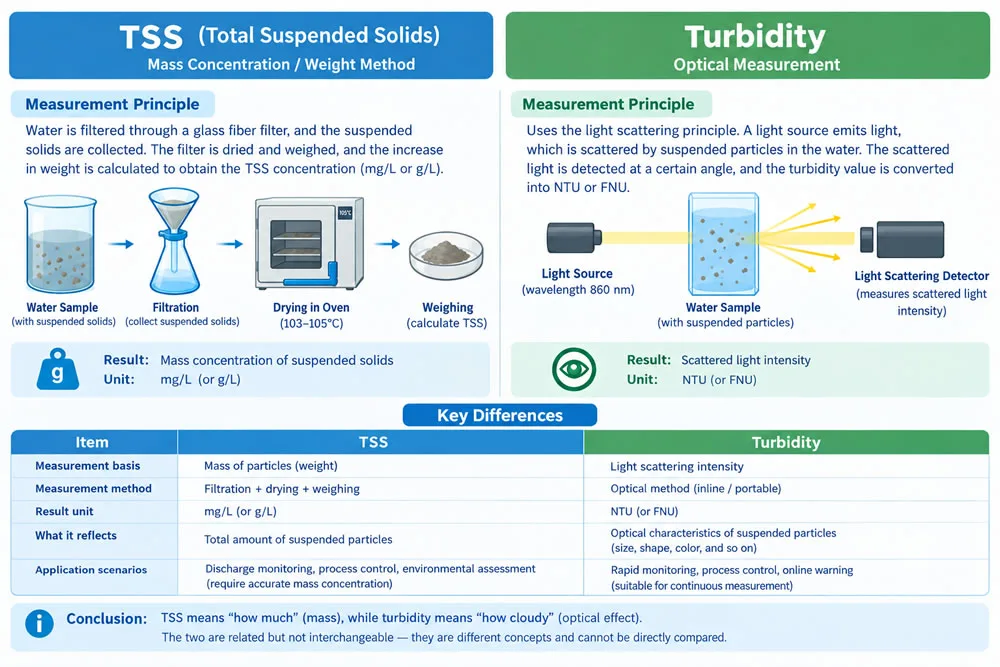
Unlike the gravimetric laboratory method, which filters a sample, dries the retained residue, and determines its mass, an online optical sensor can provide continuous measurements. U.S. EPA Method 160.2 describes the gravimetric determination of non-filterable residue/TSS and reports results in mg/L. The method applies to drinking, surface, saline, domestic, and industrial waters.
Online Measurement vs. Laboratory TSS
| Method | How it works | Typical role |
|---|---|---|
| Gravimetric | Filter, dry, and weigh retained solids | Laboratory measurement and reference testing |
| Optical online sensor | Measure optical response and convert it using an application calibration | Continuous process and water-quality monitoring |
Application-Specific Calibration Matters
An optical TSS sensor does not directly weigh suspended solids. Its response depends on the optical characteristics of the particles in the application. Particle size, composition, shape, and concentration can affect the relationship between the optical signal and TSS. For this reason, the sensor should be calibrated or verified against representative samples from the actual process when application accuracy is important.
Where Are TSS Sensors Used?
| Application | Role of TSS monitoring |
|---|---|
| Municipal wastewater | Monitor suspended solids through treatment processes and in effluent streams. |
| Industrial wastewater | Track solids changes in process water and wastewater before discharge or reuse. |
| Surface water | Monitor changes associated with runoff, erosion, sediment transport, and resuspension. |
| Aquaculture | Track changes in suspended material alongside other water-quality parameters. |
| Environmental research | Collect continuous or long-term data for investigating changes in natural water bodies. |
TSS vs. Turbidity: What Is the Difference?
TSS and turbidity are related but should not be treated as the same measurement. TSS is a concentration of suspended material reported in mass units such as mg/L, while turbidity is an optical measurement of the scattering or attenuation of light. A relationship between the two can vary with the characteristics of the particles and the water being measured.
| Parameter | TSS | Turbidity |
|---|---|---|
| Primary measurement | Suspended-solids concentration | Optical water clarity / light scattering |
| Common units | mg/L | NTU or FNU |
| Relationship | Can correlate with turbidity for a specific water matrix | Does not directly provide a universal TSS value |
| Common use | Process control, solids monitoring, discharge monitoring | Water-quality and treatment monitoring |
What Should You Consider When Choosing a TSS Sensor?
- Measurement range: choose a range that covers the expected operating conditions.
- Calibration: confirm how the sensor is calibrated for the actual water or process.
- Cleaning: automatic wiping or other anti-fouling measures can be important for long-term deployment.
- Response time: faster response can be useful when the process changes quickly.
- Installation conditions: check immersion depth, temperature, pressure, materials, and mounting requirements.
- Communication: interfaces such as RS485 Modbus RTU simplify integration with PLC, SCADA, and data-logging systems.
Kacise TSS Sensors for Online Monitoring
Kacise offers online TSS measurement solutions for different installation and monitoring requirements. The KSS300 is an online TSS analyzer with a broad measurement range and automatic mechanical cleaning. KWS-950 and KWS-910 provide additional submerged sensor options for online monitoring.
| Model | Measurement/feature | Installation/protection | Output |
|---|---|---|---|
| KSS300 | TSS 0–10,000 / 20,000 mg/L; temperature 0–60 °C; ≤±5% accuracy; 1 mg/L resolution; ≤5 s response | Automatic mechanical brush; IP68 | RS485 Modbus RTU |
| KWS-950 | Online submerged TSS sensor; application-specific selection | IP68; up to 20 m depth | RS485 Modbus/RTU |
| KWS-910 | Online TSS sensor for surface water and municipal wastewater; self-cleaning design | Online monitoring | See current product specification |
Calibration and Maintenance
Keep the optical surface clean and inspect the sensor regularly for fouling, deposits, bubbles, and installation changes. Calibration frequency depends on the application and the stability of the water matrix. For applications where TSS is used for process decisions or compliance-related monitoring, periodic comparison with representative laboratory or grab-sample results is recommended.
FAQ
Q: What does a TSS sensor measure?
A: A TSS sensor estimates the concentration of suspended solids in water, commonly reported in mg/L, using an optical measurement and calibration relationship.
Q: Is TSS the same as turbidity?
A: No. TSS is a mass concentration, while turbidity is an optical measurement. They may correlate in a specific water matrix but are not interchangeable.
Q: Why use an online TSS sensor instead of laboratory testing?
A: An online sensor can provide continuous data and faster visibility of process changes, while laboratory gravimetric testing remains useful for reference and verification.
Q: Does an optical TSS sensor need calibration?
A: Yes. Application-specific calibration or verification is important because particle characteristics can affect the optical response.
Sources and References
- U.S. EPA Method 160.2 — Total Suspended Solids / Residue, Non-Filterable
- ISO 7027-1:2016 — Water quality — Determination of turbidity
- WHO — Guidelines for drinking-water quality, fourth edition incorporating addenda
- Kacise KSS300 Online TSS Sensor
- Kacise KWS-950 Online TSS Sensor
- Kacise KWS-910 Online TSS Sensor


