







1. Project Background
At an agricultural demonstration farm in Qingdao, Shandong Province, the farm has been exploring precision nutrient and irrigation management to improve crop yield and soil health. Calcium ions (Ca²⁺) are an essential component of soil chemistry — influencing pH, soil structure, nutrient availability, and crop root development.

Excessive calcium levels or imbalanced Ca²⁺ in irrigation water can lead to soil hardening, nutrient lock-up, or reduced absorption by crops. To optimize irrigation water quality and ensure balanced soil nutrition, the farm installed the KIS-100 online calcium ion sensor for continuous monitoring of dissolved Ca²⁺ in its irrigation water distribution network.
2. Site Conditions and Monitoring Requirements
The agriculture site is a modern intensive vegetable and grain rotation farm with centralized irrigation. The calcium level of surface irrigation water varied due to groundwater sources and seasonal changes. The farm needed real-time, high-accuracy Ca²⁺ data to:
- Assess irrigation water quality and hardness
- Detect potential scaling or calcium accumulation in soil
- Adjust fertilizer and lime application during seasons
Key requirements:
- Monitoring parameter: Calcium ion concentration (Ca²⁺)
- Signal output: RS485 (Modbus RTU) connected to farm’s SCADA / PLC system
- Installation: Immersed in the irrigation channel before main field distribution
- Environmental conditions: Variable water flow, temperature, suspended solids
3. System Configuration
KIS-100 Online Calcium Ion Sensor
- Calcium ion-selective electrode designed for continuous online operation
- Integrated automatic temperature compensation for accurate Ca²⁺ measurement
- RS485 (Modbus RTU) for reliable data transfer
- IP68 waterproof design suitable for long-term immersion
- Directly connected to the farm’s monitoring terminal without additional display unit
The sensor’s robust ion-selective membrane helps reliably measure Ca²⁺ levels in irrigation water, supporting field decision systems in real time.
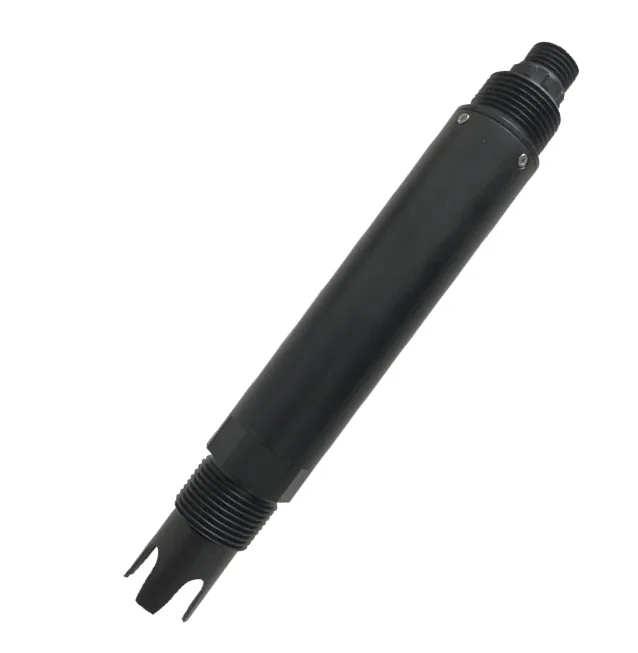
You want to know: How to use the KIS-100 Online Calcium Ion Sensor?
4. Installation and Commissioning
Deployment steps:
- Site preparation: Select representative points in main irrigation channels.
- Mounting: Install the KIS-100 sensor probe so it remains fully immersed in flowing irrigation water prior to field distribution.
- Connection: Link the RS485 output to the farm’s data acquisition system with Modbus RTU.
- Calibration: Initial calibration performed using reference calcium standards in the lab.
- Verification: Check communication and stable data reporting before going fully live.
No interruption occurred in daily irrigation processes during installation.
5. Operational Performance
After commissioning, the system provided stable Ca²⁺ data:
- Typical Ca²⁺ concentration range: ~30–150 mg/L in irrigation water
- Seasonal variance observed: slightly higher Ca²⁺ in dry spring (~120–150 mg/L) and lower in irrigation runoff after rain (~30–60 mg/L)
- Data trends correlated with crop response zones and soil hardness mapping
The continuous Ca²⁺ data allowed agronomists to fine-tune irrigation scheduling and soil amendment programs, reducing risks of soil compaction and nutrient imbalances.

6. Project Summary
The KIS-100 online calcium ion sensor enabled real-time, reliable monitoring of calcium ion concentrations in agricultural irrigation water. Using RS485 (Modbus RTU) integration with the farm’s monitoring system, the farm gained actionable insights into water quality fluctuations and their impacts on soil chemistry and crop health. This real-time data supported more efficient irrigation decisions, improved nutrient management, and enhanced overall production sustainability.
For more technical details, wiring diagrams, or model selection guidance, please click here to learn more or contact our technical team.


