







1. Project Background
A national grain reserve facility manages the long-term storage and rotation of wheat, corn, and rice. The depot contains 32 vertical silos, including:
| Material | Diameter | Height | Quantity |
|---|---|---|---|
| Wheat | 8 m | 25 m | 20 silos |
| Corn | 10 m | 30 m | 8 silos |
| Rice | 12 m | 28 m | 4 silos |
The total storage capacity reaches 150,000 tons.
Challenges Before System Upgrade
For many years, the depot relied on manual entry + single-point radar level meters, which resulted in a series of problems:
- Manual silo entry every month required operators to climb inside the silo, taking 1.5 hours per silo, with risks of:
- Dust inhalation
- Falling from height
- Single-point radar could only measure the center point, failing to detect:
- Material segregation (common in corn silos)
- Condensation and wall buildup (high-humidity rice storage)
- Local high-level zones causing structural load risks
- Volume calculation errors reached 8%–12%, affecting grain rotation planning.
- In 2023, a corn silo nearly experienced structural overload due to undetected local overfilling.
To ensure safe storage and meet modern grain reserve management standards, the depot implemented the KLD900 Series 80GHz 3D Radar Level Sensor to build a full-dimension intelligent monitoring system.
2. Equipment Selection & System Design
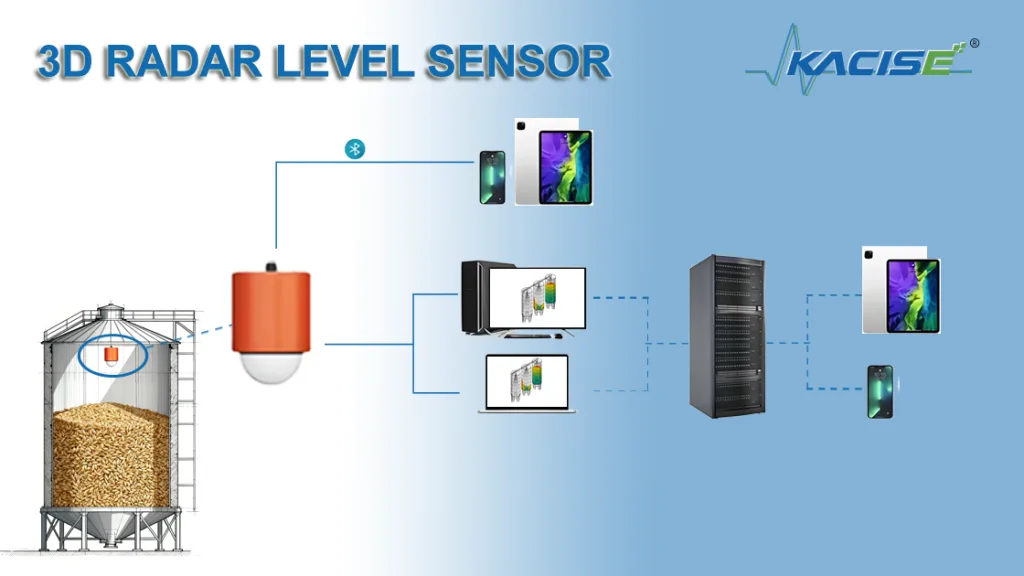
(A) Device Selection — KLD900 Series 3D Radar Level Sensor
The KLD900 was chosen because it fully meets the key requirements of high-precision measurement, 3D visualization, risk control, and large-diameter silo coverage.
Core Technical Advantages of the KLD900
(1) 360° 3D Monitoring Based on Phased-Array Technology
- Generates a full 3D point-cloud model of the material surface
- 16,200 measurement points per scan
- Identifies:
- Peaks & valleys
- Segregation
- Wall buildup
- Irregular material shapes
(2) High Accuracy & Large Coverage
| Specification | KLD900 Performance |
|---|---|
| Distance Accuracy | ±2 mm |
| Volume Accuracy | 2%–3% (full silo) |
| Effective Radius | 15 m |
| Suitable for | Silos up to Ø12 m |
One KLD900 covers even the largest rice silo, without multiple device stitching.
(3) Environmental Adaptability
- Handles dust concentration ≤ 30 g/m³ with high-frequency penetration algorithms
- Operating temperature –40℃ to 75℃
- IP68 protection, resistant to rain, snow, condensation
(4) Data Interfaces & Compatibility
- Supports Ethernet (Profinet / EtherNet/IP), Modbus-TCP, and 4G wireless
- Streams:
- 3D point-cloud data
- Level / volume data
- Fully compatible with the depot’s existing grain-condition monitoring system
(temperature, humidity, and gas sensors)
(B) System Design
(1) Device Deployment
| Silo Type | Diameter | Quantity | KLD900 Model |
|---|---|---|---|
| Wheat silos | 8 m | 20 | Standard KLD900 |
| Corn silos | 10 m | 8 | KLD900 with wide-angle module |
| Rice silos | 12 m | 4 | KLD900 with wide-angle module |
Installation method:
- Top-mounted, flange installation
- Mounted at silo center
- Minimum 4 m distance from the filling inlet to avoid grain impact
(2) System Architecture
A three-layer smart monitoring framework was deployed:
① Perception Layer
- KLD900 3D Radar Level Sensors
- Temperature & humidity sensors
- Silo wall pressure sensors
② Transmission Layer
- Industrial Ethernet LAN for 28 nearby silos
- 4G wireless for 4 remote silos
③ Application Layer
An integrated Smart Silo Monitoring Platform, featuring:
- 3D visualization
- Intelligent volume computation
- Multi-dimensional safety warning system
3.Project Implementation & Commissioning
| Stage | Key Actions | Summary |
|---|---|---|
| Installation | Site prep, flange check, center-top mounting | Install KLD900 at silo top center; DN150 flange; keep antenna level; protected cable routing |
| Calibration | Static & dynamic tests | Batch calibration (50 t/step); volume error optimized to 2–3%; stable scanning during loading/unloading |
| System Integration | Alarm & data linkage | High-level alarm → control room alert → App push → automatic inlet valve shutdown; 3D data merged with temperature & humidity system |
| Result | Deployment & stability | All 32 silos completed; accepted in 15 days; system runs reliably |
For instructions on how to select the correct flange and installation steps, please refer to manual: KLD900 Series 3D Radar Level Sensor User Manual.pdf
4.Results & Benefits
- Accuracy & Efficiency: Full-silo 3D monitoring reduced volume error to ±0.5% and cut monitoring time from 1.5 hours to 10 seconds per silo.
- Safety: Detected material segregation and wall buildup events, preventing potential structural damage.
- Management & Cost: Real-time inventory tracking; reduced labor and maintenance costs; optimized grain rotation; increased operational efficiency.
5.Conclusion
The application of 3D radar level gauges in monitoring silos at this grain storage facility has overcome the limitations of traditional monitoring methods, which were restricted to “single-point measurement and inability to control shape.” It has achieved the intelligent management goal of “visible material pile shape, accurate measurement, and controllable risk” in silos, providing a feasible solution for safe storage and efficient operation in the grain storage industry. In the future, the storage facility plans to further expand the system’s functions, combining AI algorithms to analyze trends in material pile shape changes and predict the risk of grain “condensation and overheating.” Simultaneously, 3D radar data will be integrated into the provincial grain reserve supervision platform, enabling three-level data linkage between “warehouse, city, and province,” thus promoting the digital transformation of grain reserve management.


