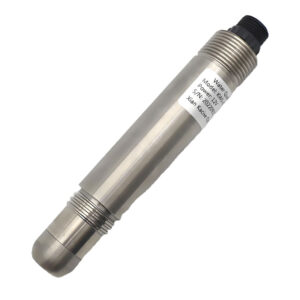




1.What is dissolved oxygen
Dissolved oxygen (short for DO) is the amount of free non-compound gaseous oxygen molecule (O2) that is present in water. It can be imaged like the salt or sugar does when it is stirred in water.It is also a critical parameter in aquatic environments and plays a vital role in the survival and health of various organisms. In simple terms, it refers to the amount of oxygen dissolved in water.
Why is Dissolved Oxygen Important?
- For fish and other aquatic animals, dissolved oxygen is like the air we breathe. They rely on it to carry out respiration and obtain the energy needed for their daily activities. Adequate DO levels support healthy growth and reproduction. Low DO levels can lead to stress, disease, and even death among aquatic species.
- It also affects the overall water quality. High DO levels can help break down organic matter more efficiently, preventing the buildup of harmful substances.
Where does dissolved oxygen come from and what determines the amount of dissolved oxygen?
2.1 Sources of dissolved oxygen
(1)Dissolved oxygen in the atmosphere:
Diffusion at the water-atmosphere interface is a key source of dissolved oxygen in water. For instance, oxygen molecules slowly dissolve from air into calm lake or river surfaces. Henry’s law states a gas’s solubility in liquid is proportional to its partial pressure. With oxygen’s atmospheric partial pressure at ~21 kPa (under standard pressure), it dissolves into water, though this process is slow. Water agitation impacts the dissolution rate: wind-driven waves on a lake increase air-water contact area, accelerating oxygen dissolution.
(2)Photosynthesis of aquatic plants:
This is another major source of dissolved oxygen in water. Aquatic plants (such as algae, water grass, etc.) absorb carbon dioxide and release oxygen during photosynthesis. The chemical equation for photosynthesis is 6CO2 + 6H2O → C6H12O6 + 6O2. For example, in a eutrophic pond, algae reproduce in large numbers. Under sufficient sunlight during the day, the oxygen produced by algae photosynthesis will significantly increase the dissolved oxygen content in the water, sometimes even reaching an oversaturated state.
2.2 Determinants of dissolved oxygen content
| Determining factors | Impact on dissolved oxygen | Detailed description |
| Temperature | Increase in temperature reduces dissolved oxygen content | As the temperature rises, the thermal motion of water molecules intensifies, and the tendency of gas molecules to escape from the water increases. For example, at 0℃, the dissolved oxygen saturation in water is about 14.6mg/L, and at 30℃ it is about 7.6mg/L |
| Air pressure | Increase in air pressure increases dissolved oxygen content | According to Henry’s law, when other conditions remain unchanged, changes in air pressure will affect the amount of dissolved oxygen. High altitude areas have low air pressure and relatively low dissolved oxygen content in water bodies; low altitude areas have high air pressure and relatively high dissolved oxygen content |
| Salinity | Increase in salinity reduces dissolved oxygen solubility | Salt ions in water interact with water molecules, reducing the chances of oxygen molecules combining with water molecules. The salinity of seawater is usually around 32‰ – 37‰, and its dissolved oxygen saturation is much lower than that of fresh water |
| Water fluidity | Flowing water can increase dissolved oxygen; still water is prone to dissolved oxygen stratification | Flowing water bodies constantly renew the water surface in contact with the atmosphere, increase oxygen dissolution, and make dissolved oxygen distribution even more. Still water is mainly supplemented by diffusion and photosynthesis, and it is easy to have a large difference in dissolved oxygen between the surface and the bottom layer, and the bottom layer may be hypoxic |
| Respiration of aquatic organisms and decomposition of organic matter | Consumption of dissolved oxygen | Biological respiration (such as C6H12O6+6O2==6CO2+6H2O + energy)) and decomposition of organic matter are oxygen-consuming processes. Too much organic matter in the water and untimely oxygen replenishment will cause a sharp drop in dissolved oxygen |
2.3 What influence the dissolved oxygen saturation quantity?
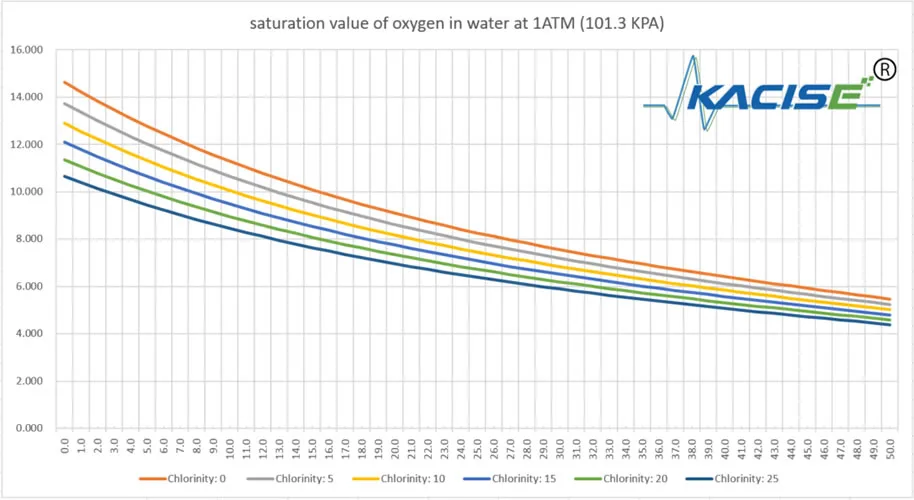
Normally the saturation of dissolved oxygen in water is almost easily effected by the water temperature, water depth, salinity, higher of the water temperature lower the value of saturation DO in water.
Higher the pressure , higher lower the value of saturation DO in water. Higher the salinity level, lower the value of saturation DO in water.
The table below is a refference pls contact us for the data of the dissolved oxygen saturation table.
3.Measuring Dissolved Oxygen
There are several methods to measure dissolved oxygen. One common way is by using a dissolved oxygen meter. It provides a quick and accurate reading of the DO level in the water sample. Another traditional approach is the Winkler titration method, which is more time-consuming but highly accurate.