







Measurement principle
During the distance measurement process, ultrasonic signals are emitted by an ultrasonic probe. After being reflected by liquids or other solid media, the signals are received by the same probe. The level measurement is achieved by calculating the time difference between the emission and reception of the ultrasonic waves. The relationship between the sound wave transmission distance (L), sound velocity (v), and sound wave transmission time (t) can be expressed by the following formula:
The basic calculation formula for ultrasonic ranging is as follows:L = (v × t) / 2
L: Distance from the ultrasonic probe to the measured material surface. Unit: meter (m);
v: Sound velocity value after temperature compensation. Unit: meter per second (m/s);
t: Travel time of the sound wave within the measurement range. Unit: second (s)
Product Description
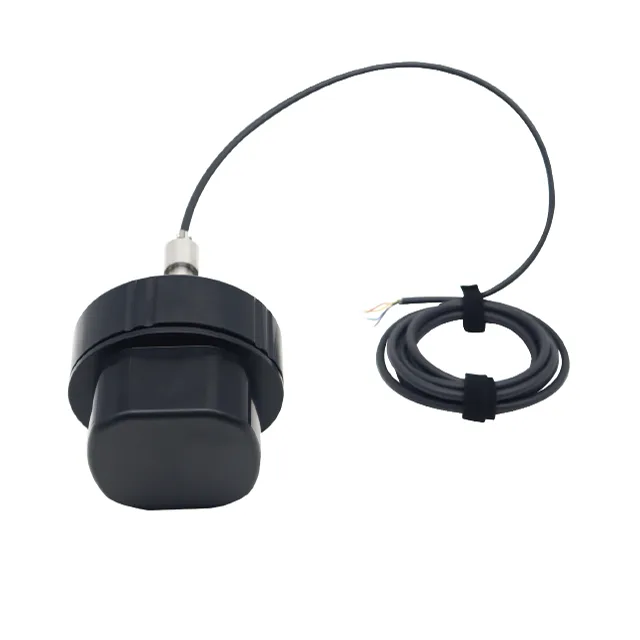
The Four-Beam Underwater Obstacle Avoidance Sensor is a multi-beam ultrasonic ranging device developed based on the ultrasonic ranging principle of “self-emission and self-reception”. It adopts a software-implemented cyclic polling testing method of “multiple emissions and single reception”, enabling distance measurement in multiple directions. Through coordinated testing across these directions, it achieves the functions of underwater obstacle avoidance and underwater distance measurement.
The sensor can store the detected data in its internal chip registers and communicate with the host computer via the Modbus protocol. Additionally, it supports adjustment between the sensor’s passive data upload mode and active data upload mode.
Technical Specifications
| Electrical Characteristics | |
|---|---|
| Operating Voltage | 10.8VDC - 26.4VDC, with Reverse Polarity Protection |
| Voltage Drop | ≤2.5V |
| Startup Delay | <1000ms |
| Output Characteristics | |
| Output Type | Standard TTL/RS485 Output (Modbus-RTU Protocol) |
| Rated Operating Current \(I_e\) | ≤60mA (24V), with Short-circuit/Overload Protection |
| Repeatability Accuracy | ±0.5% |
| Accuracy | ±0.5% |
| Environmental Parameters | |
| Operating Temperature | -20 ~ 60°C |
| Storage Temperature | -20 ~ 60°C |
| Mechanical Characteristics | |
| Material | Sensor: PC/Metal/ABS |
Product Features
- Multi-channel Cyclic Polling Test
- Fast Response Speed & High Precision
- Transducer Protection Class IP68 & 150m Water Pressure Resistance
- Equipped with TTL/RS485 Communication
- 4-pin Aviation Connector for Easy Installation
- Wide Voltage Input (10.8VDC ~ 26.4VDC)
Product Applications


